.png?width=400&height=251&name=GoSaaS-an-argano-company%20(1).png "GoSaaS - An Argano Company")
Share this
by Manas K Gupta on Sep 3, 2026, 8:00:02 AM
In today's competitive manufacturing landscape, innovation extends far beyond creating new products. Organizations are under constant pressure to accelerate product development, improve engineering efficiency, maintain regulatory compliance, and respond quickly to changing customer demands - all while managing increasingly complex global supply chains.
Product Lifecycle Management (PLM) has long served as the digital backbone for managing product information and engineering processes. Today, Artificial Intelligence (AI) is taking PLM to the next level by transforming how organizations design, develop, govern, and launch products.
Oracle Fusion Cloud SCM is leading this evolution by embedding AI directly into enterprise applications. What began with Generative AI capabilities has now evolved into a broader AI strategy that includes intelligent recommendations, natural language interactions, predictive insights, and Agentic AI - enabling organizations to make faster, more informed decisions throughout the product lifecycle.
Rather than replacing engineering expertise, AI acts as an intelligent assistant, helping teams automate routine activities, uncover valuable insights, and focus on what matters most: breakthrough innovation.
Why AI is Reshaping Product Lifecycle Management
Modern product development generates enormous volumes of information - from product specifications, engineering drawings, and Bills of Materials (BOMs) to supplier documentation, compliance records, quality reports, and engineering change histories. Managing this information efficiently has become just as important as designing the product itself.
Engineering teams often spend significant time searching for information, documenting changes, assessing downstream impacts, and coordinating across multiple business functions. These manual activities slow innovation and increase the risk of errors.
Oracle Fusion Cloud SCM addresses these challenges by embedding AI directly into PLM processes, allowing organizations to streamline routine tasks while providing contextual insights that improve decision-making. The result is a more intelligent, connected product development process where teams spend less time managing information and more time creating value.
AI Across the Product Lifecycle
Oracle's approach to AI is focused on delivering practical business value rather than introducing technology for its own sake. AI capabilities are embedded throughout the product lifecycle, enabling organizations to improve efficiency without disrupting existing workflows.
1. Smarter Product Intelligence
Finding the right product information quickly is essential for engineering productivity. AI enhances product search by understanding business context rather than relying solely on keywords. Engineers can locate similar designs, identify reusable components, discover approved alternate parts, and retrieve relevant engineering knowledge with significantly less effort.
- Impact: Reduces duplicate designs, encourages part reuse, and accelerates time-to-market.
2. Intelligent Engineering Change Management
Engineering changes are among the most critical and complex processes within PLM. A seemingly simple design modification can impact manufacturing, procurement, inventory, suppliers, quality, and regulatory compliance.
Oracle's embedded AI helps engineering teams assess these impacts more effectively by summarizing Engineering Change Orders (ECOs), identifying affected assemblies, highlighting potential risks, and providing intelligent recommendations before changes are approved.
- Impact: Eliminates manual review bottlenecks and provides contextual insights for faster, lower-risk decision-making.
3. AI-Assisted Documentation
Creating engineering documentation is a necessary but time-consuming activity. Product descriptions, technical specifications, compliance reports, supplier communications, and engineering summaries often require repetitive manual effort.
Generative AI simplifies this process by assisting users in drafting consistent, high-quality documentation while allowing engineers to review and refine the final content.
- Impact: Boosts overall engineering productivity and standardizes documentation standards across global teams.
4. Predictive Quality and Compliance
Quality and compliance have traditionally been reactive disciplines where issues are addressed only after they occur. AI is helping organizations transition to a proactive stance.
By analyzing historical quality data, supplier performance, inspection records, and engineering changes, Oracle AI can identify emerging trends and highlight potential risks before they escalate into costly disruptions.
- Impact: Improves product quality, strengthens global compliance, and reduces rework across the lifecycle.
From Generative AI to Agentic AI
Oracle's AI journey has rapidly evolved. Initial capabilities focused on Generative AI - helping users draft content, summarize information, and boost baseline productivity. Today, Oracle is expanding this vision with Agentic AI: intelligent AI Agents capable of assisting users across complete, end-to-end business processes rather than isolated tasks.
In the context of PLM, AI Agents analyze engineering data, evaluate business context, recommend next steps, coordinate information across multiple functions, and actively support decision-making.
Agentic AI in Action: The Engineering Change Process
Rather than simply generating a text summary of a change, an AI Agent can autonomously:
- Analyze all affected downstream assemblies and product lines
- Evaluate current inventory implications and scrap risk
- Identify supplier constraints and pricing impacts
- Highlight manufacturing scheduling conflicts
- Prepare comprehensive approval packages and notify relevant stakeholders - all while keeping human experts in complete control of final decisions
This evolution represents a significant leap toward intelligent enterprise applications where AI actively drives business outcomes rather than just responding to basic prompts.
Embedded AI with Enterprise Flexibility
One of Oracle's primary strengths is that AI is embedded directly within Fusion Applications, rather than delivered as a disconnected, third-party add-on.
- Unified User Experience: Users interact with AI natively within familiar business workflows, eliminating the need to context-switch between systems
- Extensible & Configurable: Organizations can extend capabilities by integrating enterprise domain knowledge and configuring AI experiences for specific business requirements
- Enterprise-Grade Governance: Leveraging Oracle's secure infrastructure ensures data privacy, governance, and regulatory compliance - critical considerations for high-tech, industrial, and life sciences manufacturing environments
Looking Ahead
Artificial Intelligence is fundamentally changing how organizations manage products throughout their lifecycle. Future PLM systems will become increasingly self-aware, capable of learning from historical enterprise knowledge and proactively guiding users through complex engineering decisions.
We can expect AI to play an even greater role across key operational areas:
- Intelligent product and material recommendations based on sustainability and cost metrics.
- Automated multi-tier impact analysis for design modifications.
- Predictive engineering insights driven by live IoT and field telemetry.
- Agentic workflow orchestration across design, procurement, and execution.
Product Lifecycle Management has always been about connecting people, processes, and product information. Artificial Intelligence adds a dynamic new dimension by making those connections smarter, faster, and more proactive.
Oracle Fusion Cloud SCM combines robust PLM capabilities with embedded AI to help organizations eliminate manual churn, boost engineering productivity, strengthen compliance, and accelerate innovation. The transition from Generative AI to Agentic AI marks the next frontier: a paradigm where AI actively collaborates with human teams to drive superior business outcomes.
As manufacturers continue their digital transformation, organizations that integrate AI into their core PLM strategy will be best positioned to deliver market-leading products faster, adapt seamlessly to disruptions, and build resilient, future-ready engineering ecosystems.
The future of PLM is here - are you ready to embrace it?
The GoSaaS Advantage
Artificial Intelligence is transforming Product Lifecycle Management, but realizing its full potential requires the right strategy and implementation expertise.
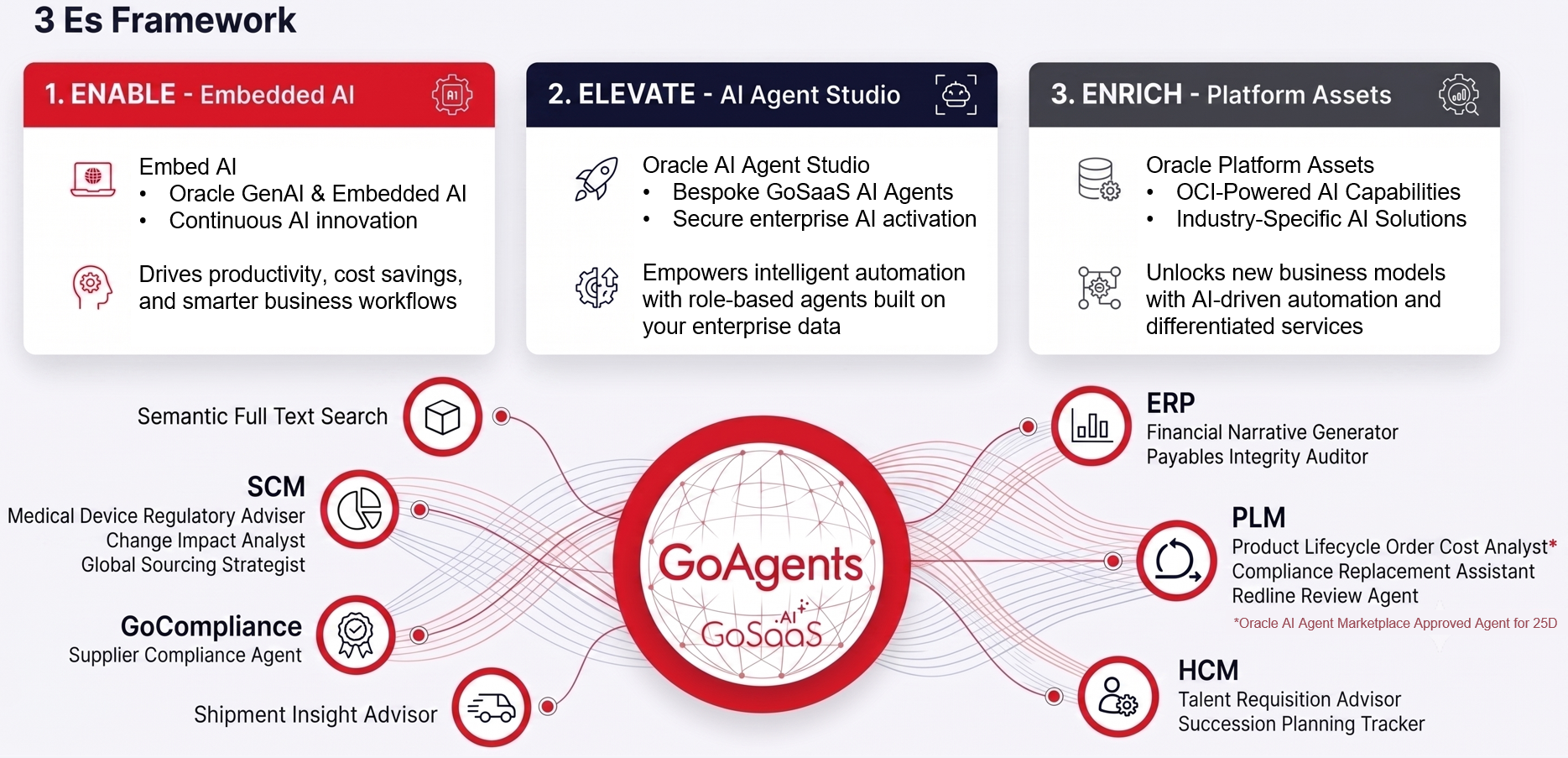
At GoSaaS, we're helping organizations accelerate AI adoption by combining Oracle's embedded AI capabilities, Oracle AI Agent Studio, and our own AI accelerators to deliver practical, business-driven solutions across Oracle Fusion Cloud.
Leveraging Oracle's embedded AI, Oracle AI Agent Studio, and GoSaaS AI accelerators, we help organizations Enable, Elevate, and Enrich their Oracle Cloud journey with practical AI solutions that deliver measurable business value.
Ready to transform your Oracle PLM journey with AI? Connect with us and explore what's possible.